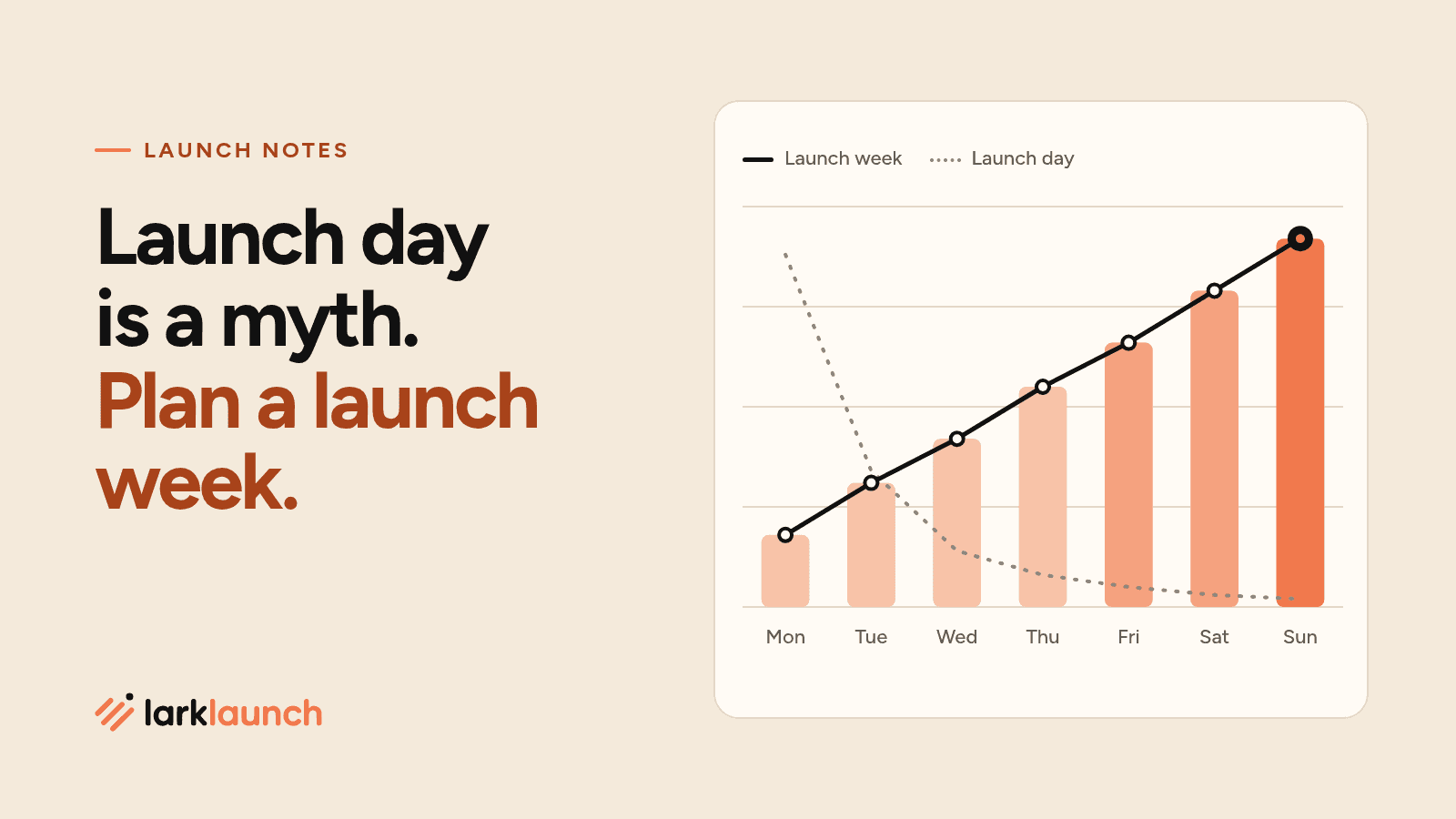
You spend six weeks building, two weeks polishing the landing page, and one evening writing the launch post. Then the launch happens, and by the time you have answered the first round of comments it is mostly over. The traffic graph looks like a cliff with a long, flat floor.
That shape is not bad luck. It is what you get when the whole plan fits inside a single day. If your post goes up at the wrong hour for your audience, or a bigger product launches the same morning, there is no second chance. Everything rides on a window you do not control.
On LarkLaunch, a launch runs for a full week, from Monday 00:00 to Sunday 23:59 UTC, and the ranking only settles when the week closes. We built it that way because a week gives a small team room to do the things that actually win users: talk to people, fix what they report, and show up again tomorrow. The plan below is built around that week, but it works wherever you launch.
The week at a glance
| Day | Focus | The one task that matters |
|---|---|---|
| Before | Get ready | Write the list of 30 people you will message by name |
| Monday | Open | Post your maker comment and send the first personal messages |
| Tuesday | Listen | Reply to every comment and ship one fix someone asked for |
| Wednesday | Tell the story | Publish one honest post about how you built it |
| Thursday | Spread | Submit to five directories that send real traffic |
| Friday | Ask | Ask three happy users for a sentence you can quote |
| Weekend | Finish | Post a recap and thank everyone who helped |
Before Monday: make the product easy to say yes to
A launch does not create interest. It concentrates attention for a few days, and the product has to convert that attention on its own. Spend the week before on the parts people see in the first ten seconds.
- A tagline that names the person and the change. “Invoices for freelance designers that get paid in half the time” beats “The future of invoicing.” If a stranger cannot repeat it back, rewrite it.
- Three screenshots and a short video. The first screenshot is your real headline, because most people never read the description. Show the product doing its main job, not the settings page. Keep the video under a minute.
- A way in without a sales call. A free tier, a trial without a card or a live demo account. People upvote what they can try in two minutes, and they comment on what they have actually used.
- Your maker comment, drafted. Why you built it, who it is for, what is still rough and the one piece of feedback you want most. Honest beats polished here.
- A list of 30 people, by name. Past colleagues, early users, the friend who keeps asking how the project is going. Not a mailing list. You will write to each of them yourself.
Monday: open with the people who already know you
Go live early in the day and post your maker comment straight away, so the first visitors see a person behind the product rather than an empty discussion.
Then work through your list. Write each message by hand and ask for something specific: “Could you try the import and tell me the first thing that confused you?” gets far better replies than “Please upvote.” Many of those people will vote anyway, and the ones who reply give you Tuesday's material.
Early votes matter on any ranked list because they decide who sees you next. Getting your first ten from people who genuinely care is the most reliable way to earn the next hundred from people who don't know you yet.
Tuesday: answer everything, then fix something
Reply to every comment within a few hours, including the critical ones. A thoughtful answer to “how is this different from X?” does more for the next reader than anything on your landing page, because it shows how you think.
Pick the most common complaint from Monday and fix it today if you can. Then say so in the thread: “Shipped a fix for the CSV bug Maya reported this morning.” Nothing builds trust faster than watching a founder respond in hours, and it gives people a reason to come back to the page.
Wednesday: tell the story nobody else can
By midweek the first wave has passed, so you need a new reason for people to look. Write one post about how the product came to exist, and put a real detail in it: what it cost to run, the feature you threw away, the month nobody signed up. Specifics travel. Generic announcements do not.
Share it where your users already spend time, whether that is X, LinkedIn, Indie Hackers or a niche forum. Link to your launch page rather than your homepage, so new readers land on the discussion and see other people already using the product.
Thursday: submit to directories that send traffic
Directories are slow, steady traffic and useful backlinks, but only if you choose them well. A long list of dead sites is worth less than five good ones. Look for real monthly visitors, a dofollow link if you care about search, and an audience that matches yours.
Our list of launch directories shows domain rating, traffic, price and link type for each, so you can filter down to the free, dofollow options in a minute. Reuse your copy, but rewrite the first line for each site's audience, and spread submissions across a few days so reviewers are not all reading the same paragraph at once.
Friday: ask for proof
By now some people have used the product for a few days. Write to the three who seem happiest and ask for one or two sentences you can quote, with their name and role. Put the best one near the top of your site the same day.
It is also a good day to publish a short changelog of the week. A list of five small fixes, each credited to the person who asked, tells new visitors the product is alive and the founder is listening.
The weekend: keep going while others stop
Plenty of founders treat Friday as the end. On a weekly leaderboard, Saturday and Sunday votes count exactly as much as Monday's, and the page is quieter, so each one moves you further.
Post a short recap: what you launched, what people asked for, what you changed and what is next. Reply to late comments. On Sunday evening, thank the people who helped, by name where they are happy to be named.
After Sunday: make the week keep paying
- The final order is saved on the past leaderboards page. Link to your week from your site and your changelog.
- Email everyone who signed up during the week. They arrived curious, and a personal note a week later converts well.
- Write down what brought people in. The next launch, or the next feature launch, starts from that list.
What not to do
- Don't buy votes or join vote rings. They are easy to spot, they get launches removed, and the people they bring never become users.
- Don't mass message strangers. A copied “upvote pls” in fifty inboxes costs you more goodwill than it earns.
- Don't launch a waitlist. If people cannot try anything, they have nothing to vote for or talk about. Launch when someone can get value on the first visit.
Ready for your week?
Launching on LarkLaunch is free. Every product is reviewed by hand and gets a full Monday to Sunday week on the leaderboard.
Launch your product